
Ideal Weight for Height Chart: Men and Women (With Formulas)
By WellnessVigor · Updated October 15, 2026 · 7 min read
This article contains affiliate links. If you buy through them, we may earn a small commission at no extra cost to you. Learn more.
“What should I weigh for my height?” is one of the most searched health questions, and there is no single perfect number. Doctors and dietitians use a few different tools: the healthy BMI range and a handful of “ideal body weight” formulas that were first built to dose medicines. This guide puts them side by side in one chart, explains where each number comes from, and shows how to use them sensibly.
Quick answer
For most adults, a healthy weight is any weight that puts your BMI between 18.5 and 24.9. For a 5′10″ man that is about 129–174 lb; for a 5′4″ woman, about 108–145 lb. Formulas such as Devine and Robinson give a single “ideal” point inside that range. Use our ideal weight calculator to get your own numbers in seconds.
Table of Contents
ToggleIdeal weight for height chart
| Height | Healthy BMI range (18.5–24.9) | Women: Devine / Robinson | Men: Devine / Robinson |
|---|---|---|---|
| 5′0″ (152 cm) | 95–127 lb | 100 / 108 lb | 110 / 115 lb |
| 5′2″ (157 cm) | 101–136 lb | 110 / 116 lb | 120 / 123 lb |
| 5′4″ (163 cm) | 108–145 lb | 121 / 123 lb | 131 / 131 lb |
| 5′6″ (168 cm) | 115–154 lb | 131 / 131 lb | 141 / 140 lb |
| 5′8″ (173 cm) | 122–164 lb | 141 / 138 lb | 151 / 148 lb |
| 5′10″ (178 cm) | 129–174 lb | 151 / 146 lb | 161 / 157 lb |
| 6′0″ (183 cm) | 136–184 lb | 161 / 153 lb | 171 / 165 lb |
| 6′2″ (188 cm) | 144–194 lb | 171 / 160 lb | 181 / 173 lb |
| 6′4″ (193 cm) | 152–205 lb | 181 / 168 lb | 191 / 182 lb |
Values rounded to the nearest pound. Heights are without shoes.
The chart below shows three numbers for each height: the full healthy BMI range (same for men and women), and the single target weight from the two most widely used ideal body weight formulas.
Where these numbers come from
Healthy BMI range. Body mass index is weight in kilograms divided by height in meters squared. The World Health Organization calls 18.5–24.9 the normal range. Because it is a range, it allows for differences in frame and muscle.
Devine formula (1974). Men: 50 kg + 2.3 kg for every inch over 5 feet. Women: 45.5 kg + 2.3 kg per inch over 5 feet. It was created to calculate drug doses, not as a health goal, but it is still the most-used ideal body weight formula in hospitals.
Robinson formula (1983). Men: 52 kg + 1.9 kg per inch over 5 feet. Women: 49 kg + 1.7 kg per inch. Robinson and colleagues revised the Devine numbers using life-insurance height and weight data.
A review of these equations found that they give similar answers at average heights but drift apart for very short or very tall people, which is why you see the gap at 6′4″ in the chart.
How to work out your own ideal weight
- Measure your height without shoes, against a wall.
- Find your healthy range: multiply 18.5 and 24.9 by your height in meters squared. Or use our BMI calculator.
- Get a single target: take the inches over 5 feet and plug them into the Devine or Robinson formula above, or let the ideal weight calculator do it.
- Check your waist: a waist measurement under half your height is a good sign, whatever the scale says.
Example: a man who is 5′10″ is 10 inches over 5 feet. Devine: 50 + (2.3 × 10) = 73 kg (about 161 lb). Robinson: 52 + (1.9 × 10) = 71 kg (about 157 lb). Both sit inside his healthy BMI range of 129–174 lb.
Want a done-for-you plan? 35 Days to a Leaner You combines a 35-day low-carb meal plan with simple home workouts, so you know exactly what to eat and how to move each day.
One exercise bike, and the whole family gets fitter
Skip the gym fees and the commute. A quiet magnetic bike lets everyone at home ride while watching TV, in any weather. Twenty to thirty minutes a day adds up to real calories burned.

Why one number is not the whole story
BMI and ideal weight formulas only look at height and weight. They cannot tell muscle from fat, so a muscular man may be “overweight” on paper and perfectly healthy. A meta-analysis of 32 studies found that a BMI of 30 or more missed about half of the people who actually had excess body fat. Waist-to-height ratio predicted heart and metabolic risk better than BMI in a large meta-analysis.
Use the chart as a starting point, then add a waist measurement and, if you can, a body fat estimate. Read more in Is BMI accurate?
Simple tools that help you track it
These are common, inexpensive options that some people find helpful. We have not personally tested these products. Links go to Amazon so you can check current prices and reviews.
BEST FOR WEEKLY CHECK-INS
Smart body composition scale
Shows weight plus estimated body fat and muscle, and syncs to your phone so you can watch the trend instead of one reading.
Pros
- Tracks trend over time
- Estimates body fat and muscle
- Inexpensive
Cons
- Body fat readings are estimates
- Accuracy changes with hydration

BEST FOR WAIST-TO-HEIGHT RATIO
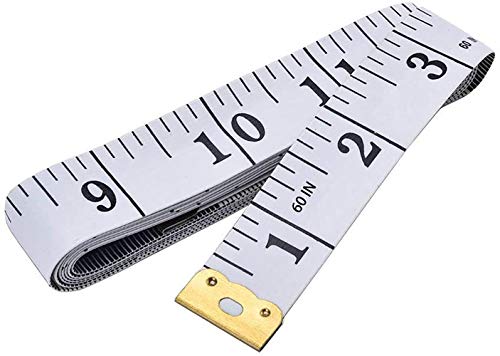
Body measuring tape
A soft, flexible tape makes waist checks quick and consistent, which tells you more about health risk than weight alone.
Pros
- Cheap and simple
- Soft and flexible around the body
- Track waist, hips and arms
Cons
- Needs the same spot each time
How to reach a healthier weight from here
If you are above your range, aim to lose 0.5–1 lb a week. That usually means eating about 300–500 calories below your TDEE. A few habits do most of the work:
- Build each meal around protein and vegetables.
- Walk 7,000–10,000 steps a day and strength train two or three times a week to keep muscle.
- Sleep 7–9 hours; short sleep raises hunger.
- Weigh yourself at the same time a few days a week and look at the weekly trend, not one day.
If you are below your range, talk to a doctor before trying to gain, especially if the loss was unplanned.
Keep reading
Frequently asked questions
What is the ideal weight for a 5′6″ woman?
The healthy BMI range at 5′6″ is about 115–154 lb. The Devine and Robinson formulas both give about 131 lb as a single target.
What is the ideal weight for a 5′10″ man?
About 129–174 lb is the healthy BMI range. The Devine formula gives about 161 lb and Robinson about 157 lb.
Is the ideal weight the same for men and women?
The BMI range is the same for both. The ideal body weight formulas give women a slightly lower number at the same height because, on average, women carry less muscle and bone mass.
Does ideal weight change with age?
The formulas do not adjust for age. Some research suggests the healthiest range may sit a little higher in older adults, so talk to your doctor about the right target for you.
Sources
- Pai MP, Paloucek FP. The origin of the “ideal” body weight equations. Ann Pharmacother. 2000.
- Robinson JD, et al. Determination of ideal body weight for drug dosage calculations. Am J Hosp Pharm. 1983.
- Okorodudu DO, et al. Diagnostic performance of BMI to identify obesity: a meta-analysis. Int J Obes. 2010.
- Ashwell M, et al. Waist-to-height ratio is a better screening tool than waist circumference and BMI. Obes Rev. 2012.
- World Health Organization. A healthy lifestyle – WHO recommendations (BMI classification).
This article is for general information only and is not medical advice. See our Medical Disclaimer..